Sunday, August 7, 2011

Unearthing Timor-Leste's Hidden Gems - Marobo's Natural Hot Springs

By Barry Greville-Eyres and Francisco Carlos de Araujo
 

En route to Bobonaro with high tropical montane forest shrouded in cloud - a rather distinctive feature


The ascent from the frontier town of Maliana (due to its close proximity to the Indonesian border) to the mountainous refuge of Bobonaro traverses a former liurais or kingdom that is breathtakingly beautiful and exceedingly interesting. Even at the height of the dry season, the rugged terrain is populated in profusion by flourishing woodlands of Casaurina (beefwood) and Erythrina (coral trees). With our ever-increasing climb on a narrow and worn road the temperature drops appreciably and many of the coral trees are ‘blushing’ with a false show of what will be a spectacular flowering display once the year-end rains arrive. Tropical montane cloud forests adorn the higher mountain peaks, creases and folds tumbling towards grassed slopes dotted by grazing cattle and browsing goat.

High noon on Bobonaro's high street - an almost idyllic life

Bobonaro - remnants of Portuguese colonial rule replaced with Timorese local government authorities

Wild, strangler fig trees wage relentless combat, bitter and knotted, with roadside rock edifices whereas cactus-like Euphorbia, in staunch ranks, herald our passing.  The hamlet of Bobonaro, once a significant Portuguese outpost in the area, boasts one high street on which many colonial-era buildings languish in various stages of dereliction. One is drawn to the local school by a strange, compelling energy – children bursting with promise, bright-eyed, lithe-limbed and busy in their enterprise of being children …… such a rarity in this fast paced and changing world. I marvel at their games – pure entertainment, ingenuity yet simplicity and I’m immediately filled with a sense of loss and regret ….. for the fading and very different childhood of my very own children.
I’m soon shaken out of my reverie by the arrival of equally bright-eyed and knowledge-thirsty suco or local authority administrators who have travelled long distances to attend the training program offered by Timor’s National Institute for Public Administration. The task of the trainers is made easier by a very captive audience – captured by their own unwavering interest and quest for discovery, self-improvement and general advancement.


Friends, colleagues and brothers in Timor-Leste's development 2nd Left-Right Maun Nuno, Flaviano and Aires taking a break during training in Bobonaro 


Prior to our return to Maliana there was the rare opportunity to stop and linger ….. specifically at the must see, must visit Marobo. As on so many previous occasions, I was content to be swept along by my friends and colleagues who too revelled in sharing something wholly Timorese, unique and exciting. On our short detour to Marobo we passed through neatly constructed and maintained homesteads, with their umalulik – sacred houses; dapur – kitchen/cooking areas and tanki – large clay, domed-shaped water storage tanks being some of the more distinctive features. Exuberant children and proud adults, people on and of this land, greeted us with generous smiles as we passed on our descent to the natural hot springs. 
Associated infrastructure in the form of an access road, retaining walls and accommodation units clearly the product of extensive Timorese toil and effort

Ruins of colonial-era 'resort' styled accommodation located on the upper slopes above Marobo's natural hot springs


On a short descent we encountered ruins and remnants of what was supposedly spa or resort styled accommodation, at a picture-perfect location, surrounded by a labyrinth of ridges and valleys. Despite conflicting reports on the origins of the development - some sources attribute it to Japanese occupation forces during WWII (1942-1945) others to the Portuguese colonial occupation-era pre-dating WWII - its highly likely that local Timorese villages were instrumental in the construction of the associated infrastructure.


Much toil and backbreaking effort must have gone into the construction of the access road; distinguishable accommodation units; hundreds of metres of retaining walls; hot water diversion, distribution and drainage systems; the main bathing pool (approximately 25mx15m); an ablution facility and individual external mineral or mud baths.  Although the facility is now clearly abandoned, it still remains an important part of Timor-Leste's natural heritage and a potential drawcard for both domestic and international tourists. There are few signs of significant degration of the resource and remaining  infrastructure and also little evidence that local villages are actually using the resource at all. Perhaps a factor of the relatively high ambient air temperature and that of water as well.  

Marobo's diverted natural hot springs leading towards a sizable bathing pool
   
Marobo's natural hot springs - once a resort and mountain retreat nestled between valley and mountain


Countless terraces and retaining walls divert the hot mineral water to individual baths and the large bathing pool

Lawless et al. 2005 in a study on the geothermal potential of East Timor described the primary hot springs at Marobo as 'M1 is a non-flowing pool with a temperature of 47 degrees C and strong gas ebullience whereas M2 discharges clear 46 degree C water with a flow of 10 kg/s and a ph 7.52.' Local villages consulted confirmed that the waterflow has remained constant throughout the decades despite prolonged periods of drought. Whereas geothermal activity or natural hot springs are not only limited to Marobo (Bobonaro District), the most appropriate use for the resource is for the more obvious tourism - health spa-oriented bathing. Despite the hot springs on Atauro Island (25 km north of Dili at various locations) seemingly having higher source temperatures (166-180 degrees C) than springs on the mainland, the temperatures are still relatively low for large-scale power generation.


Water from two different springs converge with bright green algae growing in the one
     

Nuno left and the author test out the 'invigorating' 40 something degree water  

Further natural hot springs can be found throughout the country at the following locations: Mare Naun Kura Springs (Aileu District), Wai Kana Springs (Ossu District), Wai Luli Manis and Laclota Springs (Viqueque District). 

Surrounding land-use practices of agriculture (small scale vegetable and livestock farming) appear to co-exist, harmoniously, with that of the hot springs. Local villages appear to be protecting the resource and brush and hand-packed stone walls separate adjoining agricultural land from the hot springs.


Adjoining agricultural land-use practices co-exist with that of hot springs introducing the unique prospect of sustainable agri-tourism


A parting shot of Marobo's natural hot springs - yet another of Timor-Leste's hidden gems


Thursday, August 4, 2011

Six of the Best by Barry Greville-Eyres

Out and about in Timor-Leste  Ermera and Manatutu Districts


Another day in paradise! 


Ermera's Portuguese-era Catholic Church - pre-1960's takes centrepiece in this hilltop hamlet

Beaming teenaged entrepreneurs proudly display their wares


En route to Ermera - thumbs up from the Tupperware Bandito!


Maun Nuno and Afonso enjoy classic roadside fare consisting of skewered grilled fish and steamed rice


Finis - pure gold!


Thursday, June 23, 2011

The City of Peace Rocks!


Musical mariners belt out an eclectic mix of melodies to the delight of crowds thronging the Palácio do Governo 

Dili’s residents have been subjected to a week of frenetic activity – buzzed by Black Hawk helicopters; treated to the imposing sight and superstructure of United States Ship (USS) Cleveland silhouetted against a sultry skyline; the footfalls of over 5,000 bipeds pounding the streets in the staging of the second City of Peace Marathon and the ramping up of a multi-national humanitarian assistance program, the Pacific Partnership, to Timor-Leste. Throw in the odd public holiday; stunning ‘mid-winter’ weather and with hundreds of international visitors (including many men in mottled military fatigues) gracing Dili’s shores, its fast becoming a destination for more than just peacekeepers, aid workers and accidental tourists.


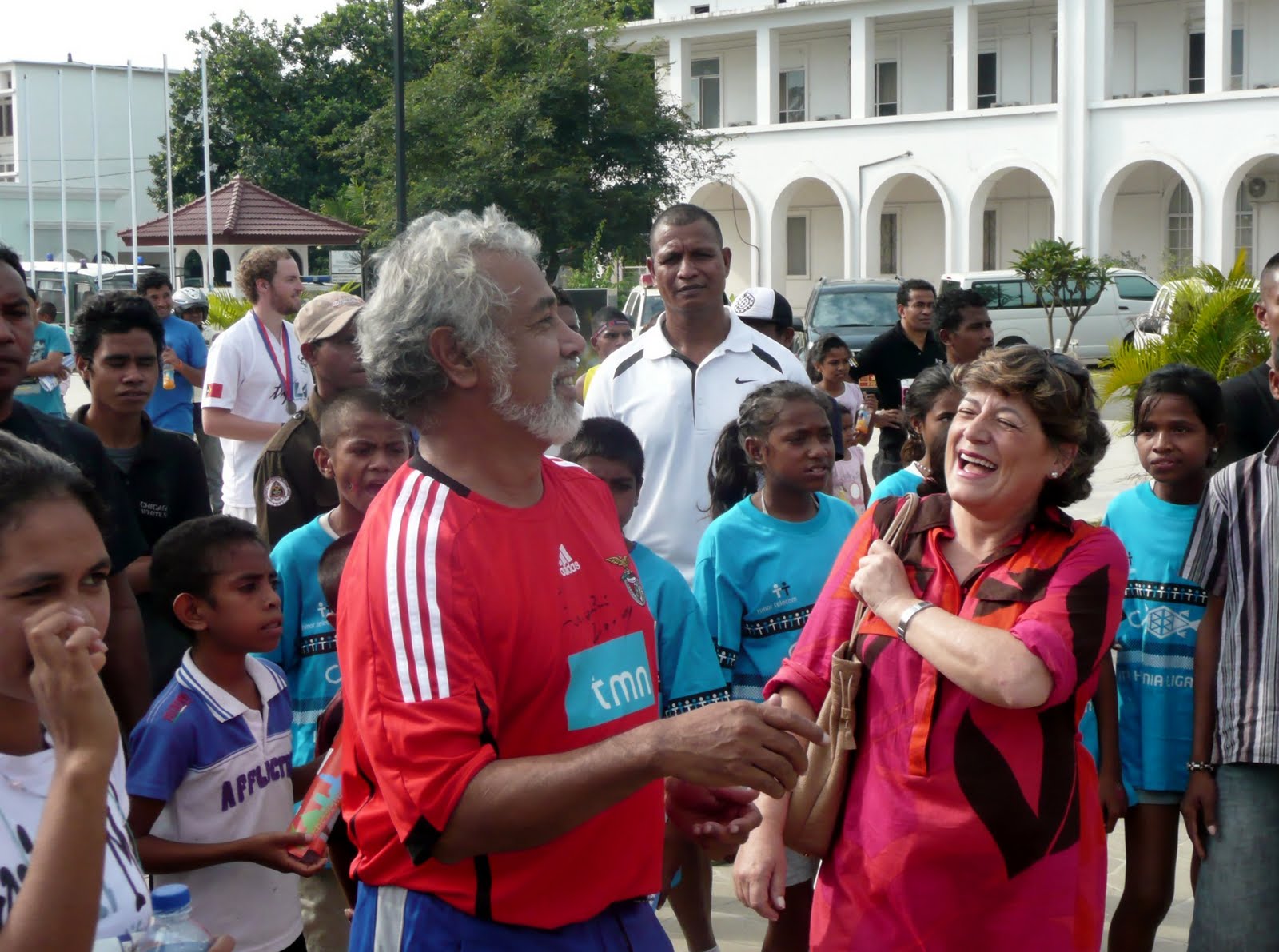
The people's premier Xanana Gusmao joins in on the festivities

Although the Timorese story has been shared, its audience has been particularly limited which makes it all the more unique and intriguing. With time, I may be able to add my own version but for now I’m content to revel and bask in this, the total Timorese experience – people that are gentle, caring, uncomplicated and refreshingly unsophisticated.  Their resilience, resolve and self-determination are legendary though and with a hefty European and Asian ‘cultural infusion’ are a wonderful blend of very old, less old, newish and pure promise of what might be through steady progression towards a decade, and beyond, of hard fought independence.


UNMIT's reassuring presence is still felt throughout Timor-Leste


Fact File: Timor-Leste
·         Purported to be one of the fastest growing economies in the world, with a stable political system and improving education infrastructure; yet
·         Timor-Leste is one of the most oil-dependent countries in the world, where more than 90% of the government’s annual budget comes from petroleum revenues;
·         Gained independence in 2002 after tripartite peace accord between Indonesia, Portugal and the people of Timor-Leste brokered by the UN;
·         Former Portuguese colony granted independence in 1975 which proved to be short-lived as the Indonesian invasion followed shortly thereafter;
·         Approximately 180,000 – 250,000 people died (close to one third of Timor-Leste’s population and also the highest per capita death toll of any conflict in the 20th century)  in sporadic unrest during Indonesia’s 24-year illegal occupation and colonization of the country;  


Dili slumbers in the early dawn whilst the crew of USS Cleveland prepare for another working day

Fact File: Timor-Leste contd.

·         Seventy percent of the country’s infrastructure was destroyed in 1999 when Indonesia and anti-independence militias went on a killing spree after the majority of Timorese voted for independence in a referendum;
·         In 2002 more than 150,000 people were displaced by political turmoil;
·         Timor-Leste is currently vying for membership of the Association of South East Asian Nations (ASEAN) and if its candidature is granted will become the eleventh member of the powerful Asian socio-economic and political bloc;
·         The United Nations Integrated Mission to Timor-Lester (UNMIT), which includes 1397 police and military advisers, is scheduled to begin withdrawing after the 2012 elections.

 
USS Cleveland - amphibious transport dock ship at anchorage off Dili


Sunday, June 12, 2011

Delectable Dili - Timor Leste


Dili's iconic Cristo Rei - various vistas and moods


Colonial fort (Portuguese) and WW2 (Japanese) Prison and Garrison west of Dili Aipelo - Liquica


East of Dili - 40 something kms


Solitary mangrove - east of Dili


Dollar Beach - pristine and ideal for snorkelling


Miss Saigon - Vietnamese fare 


Dili market produce - Comoro


Dried betelnut


Sunday, April 24, 2011

Four Seasons in Iraq

Barry recently returned from Baghdad after a year where he worked as a Development Practitioner on an Iraq-wide local governance project. 


Pitched unprepared yet willingly in the fray,
Betwixt this world and the next I could not betray,
Mixed fears and emotions though I did pray,
Enlightenment and courage to help me on my way,

Senses awry, puny resolve not knowing what to expect,
Shia, Sunni, Kurd – Iraq’s best did I soon come to admire and respect,
For hardship and sacrifice that has become their eternal quest,
Often a beginning and end wrapped in a deadly vest,

Privilege and pleasure has been our reward,
What kind of new world order are they moving toward?
Trumped up WMD traded for MDGs so universally sought,
Without political resolve and selfless stewardship this will all amount to nought.

Spring – 2011
Consolidate gains and soothe away emerging rage and endless pain,
Rejuvenating rains, thoughts and deeds hopefully clear and sane.

Summer – 2011
Decisively determine US troop drawdown or not and launch a committed country-wide program of development and reconstruction,  
An Arab League refraining from further fracturing and procrastination.

Autumn 2012
Government gets on track maintaining momentum and purpose,
The preserve of the people –serving all citizens of Iraq we propose.

Winter 2012
Ensuring that with the purest of intentions,
This does not become another Winter of discontent.


Friday, April 8, 2011

Moving from Red to Green


By Barry Greville-Eyres
Wednesday, 8 February proved to be another significant milestone in my time in Baghdad in that a small group of remaining expats was re-located from our compound in the heart of Karada to the International or Green Zone. Located on the far-side of the Tigris River and outside of the US–Iraqi military protective cordon, Karada has experienced its fair share of Al-Qaida perpetrated terrorism, sectarian violence and religious persecution in recent months.  Most notably was the late October 2010 Catholic Church massacre in which 68 congregants perished at the hands of suicide bombers. Barely blocks away from our compound, we were acutely reminded of how extreme religious intolerance is in this country and as 2010 marched inexorably towards its end, there was little respite for Baghdad’s Christian community. Families, in mixed neighborhoods, were ‘selectively’ targeted through bombings and shootings on Christian homes.


Karada Compound immediate foreground - Fourth floor view from Cedar Hotel onto the Pool Villa and the Rimal Hotel (right). Compound fortified with concrete blast or T-Walls. Residential and commercial Karada in the background.

Upon the return from my December R&R it was pretty much the case of ‘honey who shrunk my world?’ Since our firm was the sole remaining contractor operating out of Karada, the decision was made to consolidate the compound, office and accommodation space significantly.  Our new reality was reduced to two residential hotels (one occupied by all RTI staff as official accommodation), the other retrofitted to serve as office accommodation; and only one private villa retained as office space. With the shrinking of the compound and associated reduction in expat and Iraqi national security we no longer had an inner and outer security perimeter and many of us openly articulated concerns around our security  ….feeling decidedly insecure and unsafe…a sentiment echoed by most expats…. I personally visualized in graphic detail, the product of paranoia and a fertile imagination, an explosive-laden vehicle being detonated immediately adjacent to the blast/t-walls of our meager compound with sufficient force to reduce our two 5-storey residential hotels – Cedar & Rimal into heaps of rubble…. Or a group of shadowy figures breaching the compound walls and wreaking havoc on Iraqi nationals and expats alike with silenced pistols, grenades and suicide vests (a well known & versed tactic).


The end of the Karada era ...... the Baghdad team - friends and colleagues (Pic: Mark Allen)

 Iraq-Baghdad’s conferred ‘wild Middle Eastern’ status was further demonstrated and reinforced recently when the Iraqi national football team participated in the Asian Cup which eventually saw Japan defeat Australia (eina/ouch!) in the finals. Within a football obsessed and fanatical region, Iraq won and drew a game apiece before being knocked out of the competition yet on each of these occasions, local Baghdadis lit up the night sky with fireworks and small arms fire. In the words of our vigilant security detail, ‘what goes up must come down’ and we were strongly advised not to venture out onto the rooftops or our apartment balconies running the real risk of being taken out or injured by deliberate discharges or in military-speak – friendly fire (FF). Its not surprising that country-wide, a number of Iraqis are killed and injured as a result of post-match celebrations or FF.  


Arial shot of the International or Green Zone with Saddam-era Crossswords war memorial (Pic: Mark Allen)
  
We’ve barely been in the IZ a few hours and I feel like a kid in a candy store …. Van and I were given a short but royal tour, by Lamar and Shaun – head and deputy head of project respectively, of the Green Zone and start by lunching at Union – one of 2 sizable US military bases in the immediate area. Once again, it was a jaw-dropping experience and I’ve been trying to recall it in slow-mo ever since.  En route we drove passed the huge, secretive and imposing US Embassy complex, purpose built after the 2003 occupation and supposedly one of the largest worldwide, especially in terms of staffing and budget. I hope to have the pleasure of visiting it someday soon as a guest with my US colleagues ….. I figure that since the first letter of my passport begins with “A” (and both passports are a look alike - adorned in the same navy blue) and since Kevie and Hilary are such good mates this will help me get through the door – I think not but will remain ever optimistic. From what I’ve heard, the complex is completely self-contained and like a small town housing all significant US government agencies including State Department, USAID, diplomatic corps and others with every imaginable amenity available at their disposal.


Iraqi iconic war memorial in the IZ - Tomb of the Unknown Soldier (Pic Mark Allen)

The Union experience was like the M&M’s of the military (the South African equivalent of this candy is Smarties with a very appropriate jingle …. Wot-a-lot-I-got!) What was really striking was the sheer array of military combat fatigues, styles, insignia, and chameleonic camouflage. Even within the US military there is quite a range from the drab, olive green of the regular US army to the tan and sandy garb worn by the US Marines and Navy. Added to this is a strong foreign contingent from UN, NATO member and other countries including the Italians, Fijians, and eastern bloc.  As always, the food was excellent and I soon descended into SOS – sensory overload syndrome - having great difficulty savoring the experience and dividing my attention, in moderate parts, amongst my VIP work colleagues, my scrumptious Cesaer salad and the unfolding spectacle. Once more, I found myself wishing that I was an innocuous, disconnected, all-seeing fly on the wall. It’s challenging remaining cool and nonchalant under these circumstances and I hope to be back soon to continue with my Union fascination.  
Two months later ….. and the novelty of being here has yet to wear off and regular lunch forays to Union and Prosperity still prove to be interesting and entertaining. On a recent trip to the Prosperity base, the lunch time session was ‘jazzed’ up by an accomplished US Army brass ensemble performing and serenading, in silky spring sunshine, to a very ‘mixed’ outdoor audience of cleaners, kitchen staff, contractors and military personnel. Hosted in the grounds of one of Saddam’s palaces, this was yet another of those surreal experiences that one encounters here unexpectedly. I’m still in awe of the military might and machinery in Iraq although the drawdown (reduction in US forces) is well underway. In the limited contact I’ve had with US military personnel, I’ve been very impressed with their levels of discipline, morale and motivation. I’ve been addressed as Sir, from young and old alike, on many occasions and they are invariably always impeccably turned out in their military garb.   
For the handful making the move to the IZ, this represents a welcome change - infinitely more breathing space and freedom of movement compared with our closed, small claustrophobic compound that was Karada. We all seem to enjoy a greater measure of psychological security and comfort yet the IZ is in itself targeted, sporadically, by mortar and rocket attacks launched from outside the Green Zone, ironically from the burbs of Karada in many cases. We are pre-warned, occasionally, of such attacks via an antiquated public address system declaring in metallic and mechanistic monotones ….. In-coming …… In-coming….. In-coming ….. only to be followed up a few minutes later with All-clear….. All clear.
Generally, life in the IZ is very ‘normal’ and much effort has been put into keeping it that way in order for people to cope and function optimally. The bases have a range of shops – fast food and coffee; curio, carpet and art; barbers and jewelers; an ‘enterprising’ massage parlor that stipulates, in no uncertain terms, that optional extras will NOT be entertained never mind full frontal massages; odd electronic and DVD outlets retailing decidedly ‘grey’ products to mention a few. The bases also host military mini-markets or PXs that stock mostly US brands at seemingly cost and/or subsidized prices.  Outside of the bases but still within the IZ is an ‘underground’ bottle store and a few ‘local’ Iraqi mini-markets that stock an odd assortment of exotic groceries from throughout the region including countries such Turkey.


A spot of badmington in Baghdad (Karada) provided many day and night time hours of strenuous exercise and light, hilarious relief in a somewhat confined and claustrophobic setting. (Pic Mark Allen)
For many, exercise takes on a ‘ritualistic’ preoccupation and is yet another coping strategy in our somewhat abnormal existence. Each company compound / military base has all manner of exercise opportunities – basketball backboards; monthly fun runs; full gyms; specialized gym – cardio, yoga, resistance training, weight and spinning classes; volley ball courts etc….
For those so inclined, there is also a hectic ‘expat’ party scene rotated through various embassies and company compounds with copious amounts of alcohol and snack foods. They are aberrations as with men outweighing the fairer sex, every woman is in ‘red and beautiful’, has her night – day and way as they hold court over ambitious, restless and hungry hunters. Having attended a few of these events my fascination, for this side-show sub-culture, soon faded as ‘worn’ events, conversations and people began to roll into one. The Alpha-male set, with its own strict pecking order, ranges seemingly from: senior diplomatic staff / corporate life support managers / project directors and managers able to ‘keep’ women and/or offer employment opportunities for the ‘nomadic groupies’; to jaded, know-it-all senior citizen/geriatric consultants 60s plus – who are perhaps best placed spending time with their grandchildren; to Iraqi vets who seek to entertain and impress nubile and less so ‘newbies’ with their own brand of ‘war stories’ to blatant opportunists, and to the dull, wallflowers like yours truly.
Even though the Karada era is behind us, it was not without a wrench – one that I was not altogether prepared for. It was home and hearth for almost 9 months and walking out on its own unique community has been quite difficult. It’s the relationships, with expat and Iraqs alike, that I shall miss the most – Nival - my diminutive but highly efficient housekeeper; George & Larry our Philippino chefs  unruffled … with their Asian styled character/charm; the countless other restaurant staff and Hussan, our barber, who used to pamper and fuss around his regular customers. I spare a thought for and echo words of gratitude for G4S expat and Iraq national security personnel who pushed beat day and night so that we could succumb to blissful sleep, eyes closed, and escape to our other, near perfect worlds.  I often think of our Iraqi and expat work colleagues with great fondness, too many to mention by name …. Outstanding people that have come into my life in the most dramatic fashion, under abnormal circumstances and then faded out of it…………. there is a sense of loss and anxiety in our separation but equally, a celebration of hope and friendship - forged  and cherished!


Twenty something - bright, ambitious, professionals who are contemplating a future in Iraq amidst an ever increasing diaspora